

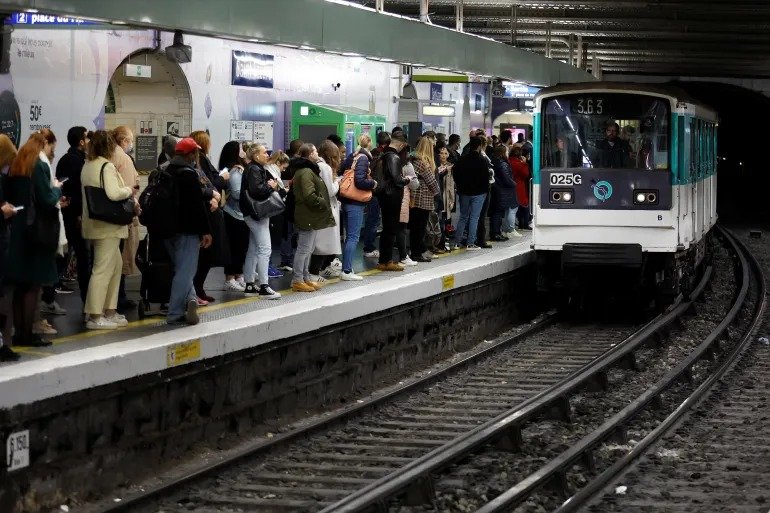
Parisians navigating their daily commutes today have found the experience considerably smoother than many had anticipated, despite a major public sector strike involving teachers, healthcare workers, firefighters, and police officers marching through the heart of the city. While the demonstration itself has drawn substantial participation, with a large march proceeding from Place de la République toward Place de la Nation, the city’s core public transportation infrastructure has continued operating largely according to its normal schedule, offering welcome relief to residents bracing for potential travel chaos.
The Paris metro system and the regional express rail network have both maintained essentially normal operations throughout today’s strike action, a notably different outcome compared to some previous large-scale strikes that have historically brought significant portions of the city’s transit infrastructure to a standstill. Only a limited number of national rail lines have experienced disruptions, allowing most residents relying on public transportation for their daily commutes to proceed with relatively minimal adjustment to their usual travel routines.
This relatively contained transit impact reflects the specific composition of today’s striking workforce, which centers primarily on public sector employees in education, healthcare, emergency services, and law enforcement rather than the transportation workers whose participation has historically driven the most severe commuting disruptions during previous major French labor actions. Residents who experienced significant inconvenience during past transit-focused strikes have expressed notable relief at today’s more limited practical impact on their daily travel patterns.
Families with school-age children have faced a somewhat more variable experience today, as individual schools have made their own determinations about whether to maintain normal in-person instruction based on specific staffing levels and local teacher participation in the broader strike action. Parents in affected districts described checking directly with their children’s specific schools the evening before, reflecting the genuinely unpredictable nature of participation levels that can vary considerably even within the same broader coordinated strike action.
Local businesses along the demonstration route have adjusted their operations to accommodate both the marching crowds and the associated security presence, with some establishments reporting increased foot traffic from demonstration participants while others have temporarily modified their usual operating patterns given the altered pedestrian and vehicle flow through affected streets. This mixed commercial impact illustrates how large-scale demonstrations create genuinely varied experiences for different businesses depending on their specific location relative to the march route and its associated security perimeter.
Healthcare facilities across the city have maintained essential patient care services throughout the strike, even as many healthcare workers joined the broader demonstration to voice concerns about working conditions and compensation. This pattern of ensuring continuity of critical services while still enabling meaningful worker participation in broader political action reflects an established approach that has become standard practice during French public sector labor disputes affecting essential services.
As today’s demonstration continues through the afternoon, the relatively limited disruption to daily commuting and transit has allowed many Parisians to observe or even participate in the broader political action without experiencing the kind of severe practical inconvenience that has characterized some previous major strikes. This outcome likely reflects both the specific composition of today’s striking workforce and effective advance planning by transit authorities working to maintain essential service continuity even amid significant public demonstrations occurring throughout the city.
