

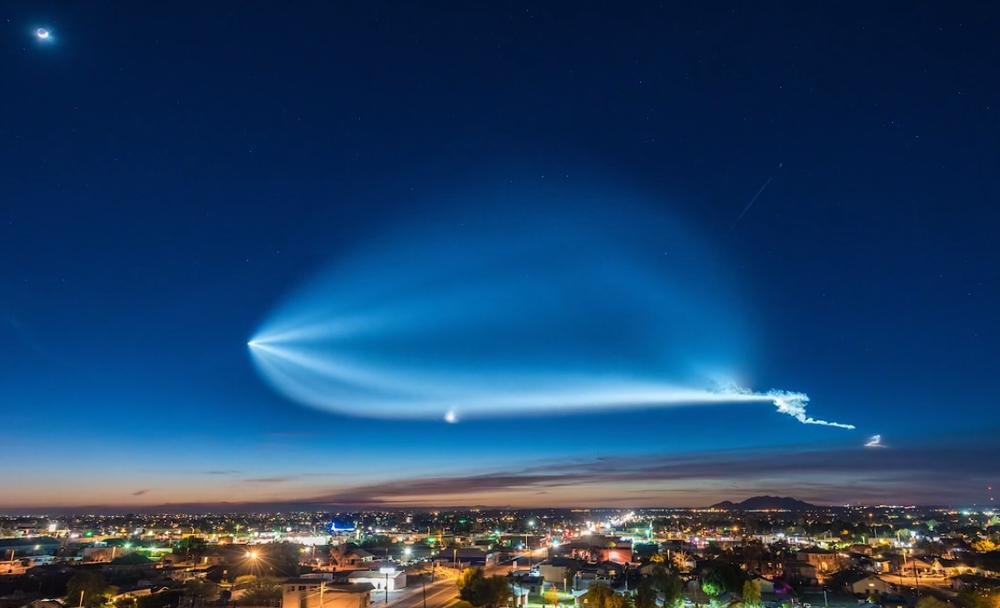
A SpaceX Falcon 9 launch created an extraordinary spectacle over the northeastern United States early Tuesday, August 25, as a glowing, jellyfish-shaped plume appeared above New York City. The unusual formation was produced by the rocket’s exhaust as it climbed into the atmosphere, where sunlight illuminated the expanding plume against the dark morning sky. Images and videos of the phenomenon quickly attracted attention because the shape resembled a giant glowing jellyfish floating above Manhattan.
The phenomenon was connected to a Falcon 9 launch from Florida. Although rocket launches are increasingly familiar along the U.S. East Coast, atmospheric conditions can transform an ordinary launch into a visually striking event. When a rocket climbs high enough, its exhaust expands dramatically in the thinner upper atmosphere. If the timing and angle of sunlight are right, the gases can become visible even when the launch site itself is hundreds of miles away.
The August 25 display was particularly noticeable over New York because the expanding exhaust plume contrasted sharply with the dark sky and the city’s illuminated skyline. The effect produced a broad, luminous structure that appeared to change shape as the rocket continued its ascent. Reuters imagery showed the plume moving above Manhattan skyscrapers after the Falcon 9 launch.
The science behind such displays is relatively straightforward, even though the result can look otherworldly. Rocket engines release hot exhaust containing gases and other combustion products. At high altitude, those materials expand rapidly because atmospheric pressure is much lower. Sunlight can then illuminate the particles and gases from above the horizon, creating a glowing cloud.
This is also why rocket launches can sometimes generate colors and shapes that appear completely different from what observers see near the launchpad. The exhaust is interacting with the atmosphere under changing pressure and temperature conditions. Perspective also plays an important role: from hundreds of miles away, the plume can appear much larger and more unusual than it would from close to the launch site.
The event illustrates how America’s growing commercial space industry is changing not only access to orbit but also the night skies visible from populated areas. SpaceX conducts frequent Falcon 9 missions for communications satellites, scientific payloads and other customers. As launch frequency increases, more people are likely to encounter unusual atmospheric effects associated with rocket launches.
For scientists and skywatchers, these events also provide an opportunity to explain atmospheric physics to the public. A phenomenon that initially looks mysterious can demonstrate how sunlight, altitude, atmospheric density and rocket propulsion interact. The visual spectacle therefore becomes a form of informal science education.
The August 25 event also highlights the geographical reach of modern American spaceflight. A rocket can launch from Florida while producing a visible atmospheric display over New York and other parts of the East Coast. The distance between the launch site and observers makes the event especially striking because the plume can appear detached from the technology producing it.
For residents who witnessed the glowing formation, however, the science may have been secondary to the spectacle. The sight briefly transformed the New York skyline into something resembling a scene from science fiction, showing once again that America’s increasingly busy launch schedule can produce unexpected consequences far beyond the spaceport.
