

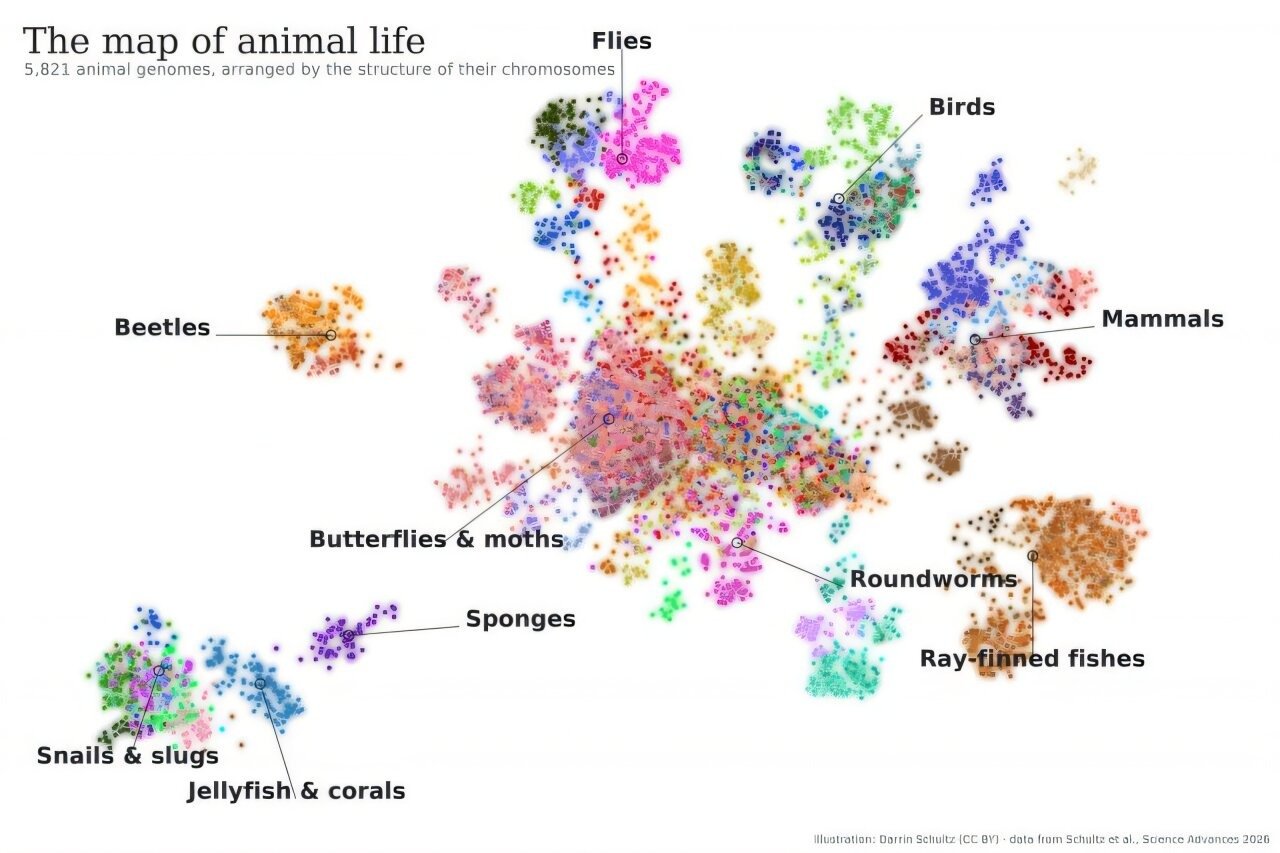
A massive comparison of animal genomes has provided scientists with a new view of how chromosomes have changed over hundreds of millions of years, revealing what researchers describe as “evolutionary highways” that appear to have guided genetic change across the animal kingdom. The study, highlighted on August 25, examined thousands of chromosome-scale genomes from thousands of animal species.
Researchers analyzed more than 5,800 chromosome-scale genomes representing 4,454 species across 19 major animal groups. The scale of the comparison allowed scientists to examine chromosome evolution across a far broader section of the animal tree of life than was previously possible.
Chromosomes are structures that organize an organism’s DNA. Over evolutionary time, chromosomes can split, fuse, rearrange or undergo other structural changes. Scientists have long known that such changes occur, but reconstructing their history across thousands of species is extremely difficult.
The new analysis suggests that chromosome evolution is not completely random. Instead, researchers identified patterns indicating that certain changes occurred repeatedly while other possible arrangements appear to have been avoided. The result resembles a network of evolutionary routes through which chromosomes repeatedly travelled.
This does not mean that animal evolution follows a predetermined script. Evolution remains shaped by mutation, natural selection, genetic drift and environmental pressures. However, the structure of genomes can impose constraints on what changes are more likely to persist.
The research covers an extraordinary period of biological history. Animals share ancestry stretching back more than 600 million years, and their genomes have been reshaped continuously during that time. Comparing modern species provides researchers with clues about the genetic architecture of their distant ancestors.
One of the most important advances behind the study is the growing availability of chromosome-scale genomes. Earlier genetic databases often contained sequences showing which genes an organism possesses but did not always reveal their precise arrangement along chromosomes. That limited scientists’ ability to compare large-scale chromosome structures.
More complete genomes make it possible to ask different questions. Instead of simply examining individual genes, researchers can study how entire sections of DNA have moved or changed position over evolutionary time.
The findings could also improve scientists’ understanding of animal biodiversity. If some chromosome arrangements repeatedly appear across different evolutionary branches, those patterns may reveal structural features that are particularly stable or advantageous.
At the same time, the study demonstrates the value of large genomic datasets. No individual species could reveal these broad evolutionary patterns. The discovery required researchers to compare thousands of genomes across distant branches of the animal kingdom.
The work could eventually contribute to research in fields ranging from conservation biology to evolutionary genetics. Understanding how genomes change may help scientists reconstruct the history of endangered species, identify unusual genetic patterns and better understand why some evolutionary changes are more difficult than others.
The research also provides a reminder that evolution is both flexible and constrained. Species have diversified into extraordinary forms, from insects and fish to birds and mammals, yet the underlying architecture of their chromosomes appears to have followed recognizable routes.
For the public, the idea of evolutionary “highways” offers an accessible way to understand a complex genomic discovery. Rather than imagining evolution as a completely open road where every genetic arrangement is equally possible, scientists are finding evidence that biology may provide certain routes that are easier to travel than others.
The study does not rewrite evolutionary theory, but it adds another layer to scientists’ understanding of how life changes. By comparing thousands of genomes at chromosome level, researchers are beginning to see patterns that were invisible when genomic information was available only for a much smaller number of species.
