

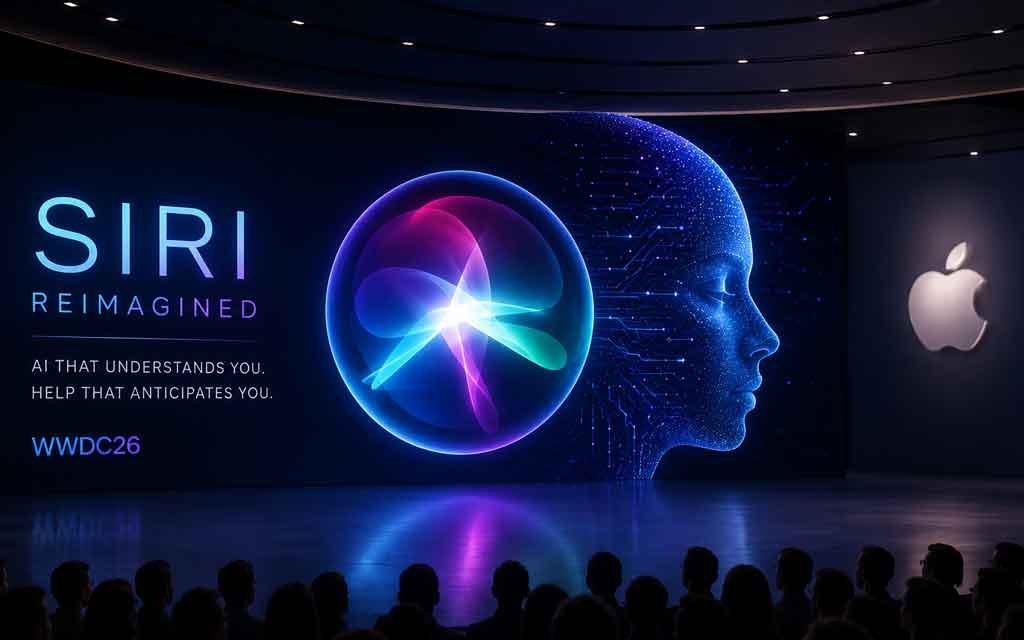
Apple has begun rolling out its long awaited Apple Siri AI launch, introducing a ground up rebuild of its voice assistant powered by custom technology developed in collaboration with Google. The redesigned assistant marks the most significant overhaul of Siri since its original debut more than a decade ago.
The new version functions as a complete conversational assistant, offering web search, image generation, content summarization, coding assistance, file analysis, and multi step command execution. This represents a dramatic expansion beyond the more limited voice commands users have grown accustomed to over the years.
Under the partnership, Apple gains access to a custom large scale AI model built specifically for its needs, while processing user queries through Apple’s own private cloud computing framework. The company says this approach uses end to end encryption and hardware isolated processing environments, with no user data shared with its technology partner and nothing stored after processing completes.
The rebuilt assistant supports significantly longer conversational exchanges compared to previous versions, allowing users to maintain context across more than twenty consecutive dialogue turns. This represents a substantial leap in conversational memory, enabling more natural, flowing interactions rather than isolated single commands.
Developers building applications for Apple’s platforms will also see new opportunities through an accompanying extensions marketplace, allowing third party AI integrations to build directly on top of the upgraded assistant’s infrastructure. This creates new possibilities for how outside developers can enhance the assistant’s capabilities.
The general release follows a staged rollout that began with developer betas earlier in the year, followed by public beta testing over the summer months. The free general release reaching all eligible devices coincides with the broader operating system update rolling out this fall across Apple’s product lineup.
This partnership marks a notable strategic shift for Apple, which had faced growing pressure in recent years as its voice assistant lagged behind competing AI powered tools in terms of conversational sophistication. Rather than building comparable technology entirely in house, the company chose to license capability already proven successful elsewhere.
Industry analysts note that this deal reflects the increasingly complex web of partnerships forming across major technology companies as they race to remain competitive in artificial intelligence. Even companies that compete directly in other areas are finding value in strategic collaboration on specific technology components.
Privacy advocates have closely scrutinized the arrangement given the sensitive nature of data flowing through personal voice assistants. Both companies have emphasized their privacy safeguards, though some experts continue calling for greater transparency regarding exactly how user queries are processed and secured throughout the system.
Regulatory attention has also followed the announcement, with antitrust officials in multiple regions reviewing the implications of such a significant partnership between two of the world’s largest technology companies. The companies maintain that the arrangement focuses narrowly on technology licensing rather than any broader anticompetitive purpose.
As the rollout continues across eligible devices in the coming weeks, both companies will be closely watching user adoption and feedback. If successful, this partnership could reshape user expectations for what a built in voice assistant should be capable of, setting a new standard across the broader technology industry.
